
You filed your income tax return, and then you spotted a mistake. Maybe you missed some bank interest. Maybe you claimed the wrong deduction. Maybe you picked the wrong ITR form. Do not panic. For AY 2026-27, you can still fix it with a revised return.
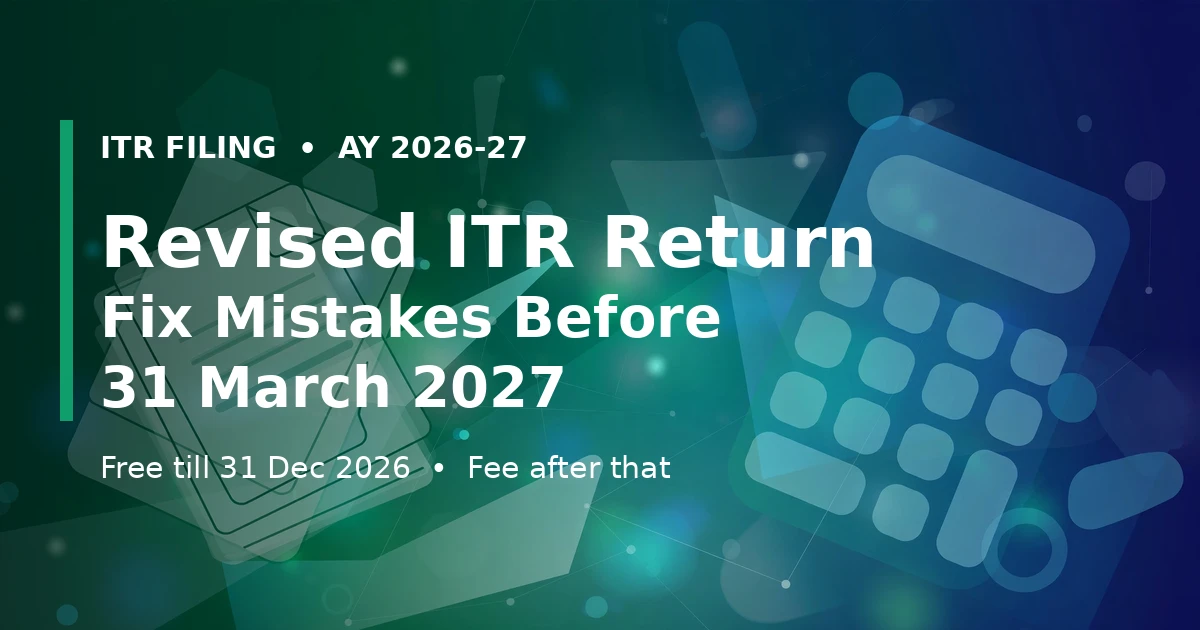
Quick answer: You can file a revised ITR return free of charge up to 31 December 2026. If you miss that date, you still have time until 31 March 2027, but a fee under Section 234-I applies: Rs 1,000 if your total income is up to Rs 5 lakh, and Rs 5,000 if it is above Rs 5 lakh.
What is a revised ITR return?
A revised return is filed under Section 139(5) of the Income-tax Act, 1961. When you file one, it replaces your original return for that assessment year. For assessment purposes, the department then works only with the revised version.
That replacement is the whole point. You do not file a small correction note. You file a complete return again, with the corrected figures in place.
One note on which law applies. For AY 2026-27, which covers income earned in FY 2025-26, the return is still governed by the Income-tax Act, 1961. The Income-tax Act, 2025 applies from the next year. That is why this guide uses the 1961 section numbers: Section 139(5) for a revised return, Section 139(4) for a belated return, and Section 139(8A) for an updated return. At section level, return filing under the 2025 Act is Section 263, but the AY 2026-27 rules in this article are the 1961 rules.
What is the last date to file a revised ITR for AY 2026-27?
The short answer has two dates, and the difference between them is money.
- Up to 31 December 2026: no fee. This is the free revision window. If you know about a mistake now, in October 2026, this is the window to use.
- 1 January 2027 to 31 March 2027: fee applies. Budget 2026 and the Finance Act, 2026 extended the revision window from 31 December to 31 March. The extension is not free. A fee under Section 234-I applies: Rs 1,000 if your total income does not exceed Rs 5 lakh, and Rs 5,000 in all other cases.
- After 31 March 2027: no revision. The revision window closes. The only route left after that is an updated return, which is a different and costlier tool (see below).
There is one more early cut-off to know. The window also closes if your assessment is completed before the date. That sounds scary, but it has a clear limit: processing of your return and an intimation under Section 143(1) is not completion of assessment. If you have only received a 143(1) intimation, you can still revise.
By the numbers
- 31 December 2026 – last date to revise free of charge for AY 2026-27.
- 31 March 2027 – extended last date for a revised return, with a Section 234-I fee.
- Rs 1,000 / Rs 5,000 – Section 234-I fee for revisions filed between 1 January and 31 March 2027, split by whether total income exceeds Rs 5 lakh (Finance Act, 2026; confirmed in the Income Tax Department’s FAQs via Taxmann).
- 30 days – time to e-verify a revised return after filing it, or it is treated as not filed.
- 48 months – the updated-return (ITR-U) window from the end of the assessment year, with additional tax of 25% to 70%.
Revised return vs belated return vs updated return: what is the difference?
People mix up these three names. Here is the plain version.
| Route | Section | What it is | Last date for AY 2026-27 | Cost |
|---|---|---|---|---|
| Revised return | 139(5) | Fixes a return you already filed | 31 December 2026 free; 31 March 2027 with fee | No fee up to 31 December 2026; Rs 1,000 / Rs 5,000 under Section 234-I after that |
| Belated return | 139(4) | Your first return, filed after the original due date | 31 December 2026, or assessment completion, whichever is earlier | Late fee under Section 234F: Rs 5,000, or Rs 1,000 if total income is up to Rs 5 lakh, plus interest where it applies |
| Updated return (ITR-U) | 139(8A) | A last-resort return filed after the other windows close | Up to 48 months from the end of the assessment year | Additional tax of 25% to 70% of the tax and interest due; no refund, and it cannot reduce your income |
A belated return is simply a first return filed late. It can itself be revised under Section 139(5) while the revision window is open. What it cannot do is turn back into an original return for loss carry-forward purposes: business and capital losses generally need a return filed by the original due date.
An updated return is different in kind. It cannot claim a refund, reduce your income, or be revised. Its only job is to let you pay extra tax on income you missed, at a known extra cost, instead of waiting for the department to find it.
What mistakes can you fix with a revised ITR return?
A revised return can fix almost any genuine error in a return you already filed. The common ones are:
- Missed income. Interest from a savings account or fixed deposit, rent, freelance receipts, or dividend income that did not make it into the original return.
- Missed TDS credit. Tax deducted by a bank, employer, or client that shows in Form 26AS or AIS but was not claimed.
- Wrong ITR form. If you filed ITR-1 when your income profile needed ITR-2, you can fix it by filing a revised return and choosing the correct form. This is the standard fix for a wrong-form filing, and it must be done inside the revision window.
- Wrong bank account. The account for a refund, or a wrong account number typed in a hurry.
- Missed deduction. An 80C investment, health insurance premium, or other deduction you forgot to claim.
- Income under the wrong head. For example, business income shown as income from other sources, or the other way round.
A worked example shows why December matters. Suppose you filed in July 2026 and in November you find Rs 60,000 of fixed-deposit interest missing. Revise in November and there is no revision fee, only the extra tax and interest on the corrected income. Wait until February 2027 and you pay the same tax and interest, plus a Section 234-I fee of Rs 1,000 or Rs 5,000. The correction is the same. The delay costs money.
How to file a revised ITR return online
The steps on the e-filing portal are short. Keep your original acknowledgement number and date ready.
- Log in to the e-filing portal at incometax.gov.in with your PAN and password.
- Go to e-File, then Income Tax Return, then File Income Tax Return.
- Choose Revised Return under Section 139(5).
- Enter the acknowledgement number and date of the original return you are revising.
- The portal will show your original return data. Change only the fields that need correction, but check the full return before you submit. A revision is a complete return, not a short note about one change.
- If you are changing the ITR form, select the correct form for your income profile at this stage.
- Preview the full return. Match the income and TDS figures against Form 26AS and AIS.
- Submit the return. You will get a new acknowledgement number for the revised return.
- E-verify the revised return within 30 days, using Aadhaar OTP, net banking, or any other method the portal offers. If you miss the 30 days, the revised return is treated as not filed. Our step-by-step guide to how to e-verify your ITR covers all seven methods.
If you have not filed at all yet, a revised return is not your route. You need a belated return instead: see our belated ITR filing guide for AY 2026-27. If you are unsure which form applies, see which ITR form to file, ITR-1 to ITR-7.
What happens after you revise your ITR?
After you file and e-verify the revised return, the department processes it again. Three outcomes are possible:
- A new refund. If the corrected figures show you overpaid, a fresh refund goes to the bank account in the revised return. Track it in our income tax refund status guide.
- A fresh demand. If extra tax is due, a demand notice follows. Pay it on time to stop interest running further.
- A fresh intimation under Section 143(1). The new intimation reflects the revised computation. Only the latest one counts.
There is no limit on revisions before the deadline. Each one must be e-verified within 30 days, and the last one filed before the deadline is the one that counts.
What can a revised return not do?
- It cannot revise an updated return (ITR-U). Once you file an ITR-U, that route is closed to revision.
- It cannot be filed after your assessment is completed. Processing and a 143(1) intimation do not block you, but a completed assessment does.
- It cannot turn a belated return into an original return. The loss carry-forward limits of a belated return stay, even after revision.
- It cannot fix a return that was never filed. With no original return, the route is a belated return (up to 31 December 2026) or, after that, an updated return.
- It cannot wait. The free window ends on 31 December 2026. A mistake found in January 2027 is still fixable, but only with the Section 234-I fee, and only up to 31 March 2027.
Mistakes to avoid while filing a revised return
- Typing the wrong acknowledgement number. Copy it from the original acknowledgement, not from memory.
- Skipping the AIS and 26AS check. Most missed-income mistakes are visible there. Check both before you submit.
- Forgetting to e-verify the revision. The original return’s verification does not carry over. The revision needs its own e-verification within 30 days.
- Submitting without a full preview. Read the whole return once. A second mistake costs another round of filing.
- Waiting for the last week of March. Portal load or a forgotten password can eat days. A December revision is free. A March revision costs a fee and carries deadline risk.
Frequently asked questions
What is the last date to file a revised ITR for AY 2026-27?
You can file a revised return free of charge up to 31 December 2026. After that, you have until 31 March 2027, but you must pay a fee under Section 234-I: Rs 1,000 if your total income is up to Rs 5 lakh, and Rs 5,000 if it is above Rs 5 lakh. The window also closes earlier if your assessment is completed first.
Can I revise a belated return?
Yes. A belated return filed under Section 139(4) by 31 December 2026 can be revised under Section 139(5), as long as the revision window is still open. The late fee that applied to the belated return itself is separate from any Section 234-I revision fee.
Is there a fee for revising after 31 December 2026?
Yes. For revisions filed between 1 January 2027 and 31 March 2027, Section 234-I prescribes a fee of Rs 1,000 where total income does not exceed Rs 5 lakh, and Rs 5,000 in all other cases. Revisions filed on or before 31 December 2026 carry no revision fee.
Can I revise my ITR after it has been processed?
Yes. Processing and an intimation under Section 143(1) do not count as completion of assessment. You can still revise as long as the revision deadline has not passed and your assessment has not been completed.
How many times can I revise my ITR?
There is no limit on the number of revisions before the deadline. Each new revision replaces the previous one, and each one must be e-verified within 30 days.
What is the difference between a revised return, a belated return and an updated return?
A revised return under Section 139(5) replaces a return you already filed and fixes its mistakes. A belated return under Section 139(4) is a first return filed after the original due date. An updated return under Section 139(8A) is filed after the other windows close, only to pay extra tax, with additional tax of 25% to 70%, and it cannot claim a refund or be revised.
Can I file a revised return if I used the wrong ITR form?
Yes. Filing a revised return and choosing the correct ITR form is the standard way to fix a wrong-form filing. Do it inside the revision window, and check that the new form covers all your income heads and disclosures before you submit.
Official sources
- Income Tax e-filing portal: https://www.incometax.gov.in/
- Income Tax Department, India: https://incometaxindia.gov.in/
- Finance Act, 2026 provisions on the revised-return extension and Section 234-I fee, as summarised in the Income Tax Department’s AY 2026-27 FAQs.
Reviewed by Asuthod Rathod, CA | Last updated: 24 October 2026
Disclaimer: This guide gives general information only. It is not tax advice for your specific case. Tax rules and portal steps can change, so check the latest position on incometax.gov.in or speak to a qualified tax professional before you file.

Editorial byline for eircicai freelancer tax and ITR filing guides — covering 44ADA presumptive tax, advance tax, and ITR filing. Content is reviewed by Asuthod Rathod, CA.