
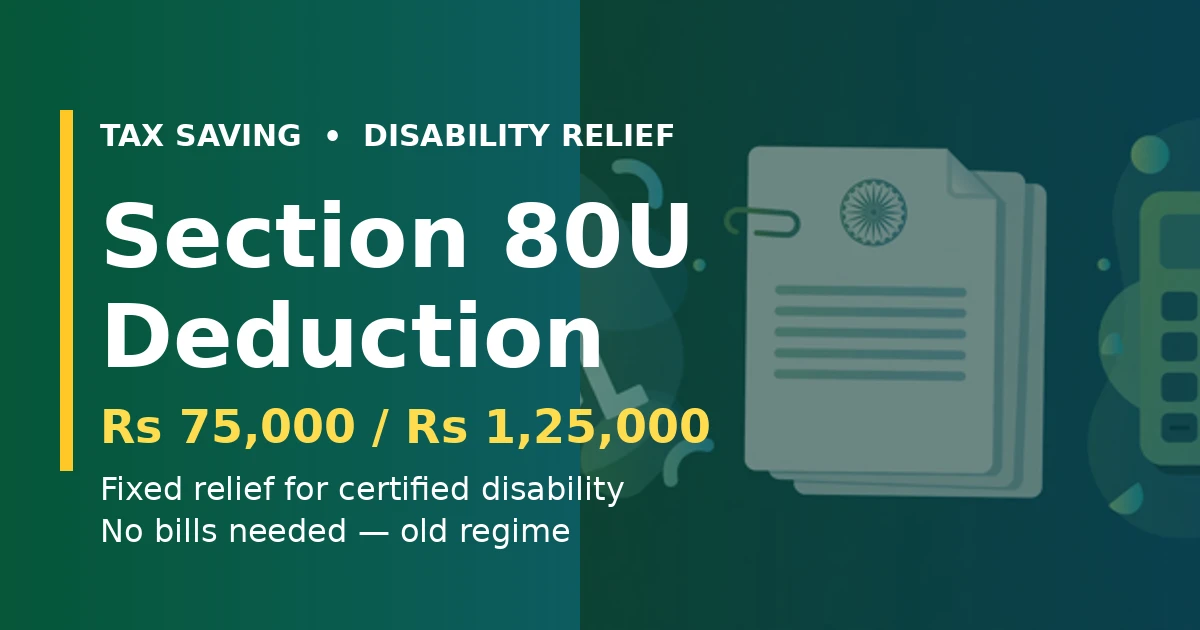
Quick answer: Section 80U gives a fixed tax deduction of Rs 75,000 to a resident individual with a certified disability of 40% or more, and Rs 1,25,000 for severe disability of 80% or more. The amount does not depend on medical bills. For returns filed now, for AY 2026-27, you must use the old tax regime to claim it.
Section 80U is one of the simplest deductions in the Income-tax Act. It does not ask how much you spent on treatment. It asks one question: do you hold a valid disability certificate from the prescribed medical authority? If the answer is yes, a fixed amount comes off your taxable income.
This guide covers who can claim it, the two fixed amounts, which disabilities count, the Form 10-IA certificate rules, how to claim it in your return, and how 80U differs from Sections 80DD and 80DDB. It also covers the section-number change under the Income-tax Act, 2025.
What is Section 80U?
Section 80U of the Income-tax Act, 1961, is a Chapter VI-A deduction for a resident individual who is certified as a person with disability. The disability must exist at some point during the previous year for which you file the return. The deduction is claimed by the person with the disability, for their own disability. It is not a deduction for a family member’s disability. That case falls under Section 80DD, explained below.
The key point about 80U is that it is a flat deduction. Your medical bills, therapy costs, and insurance premiums do not change the amount. The certificate decides the amount: 40% or more disability gives one figure, 80% or more gives the higher figure.
Like all Chapter VI-A deductions, the 80U deduction cannot be more than your gross total income. If your gross total income is lower than the deduction amount, the excess does not carry forward. It simply goes unused for that year.
What is the Section 80U deduction limit?
| Disability level | Certificate threshold | Fixed deduction |
|---|---|---|
| Person with disability | 40% or more | Rs 75,000 |
| Person with severe disability | 80% or more | Rs 1,25,000 |
These two amounts are alternatives, not additions. A person with severe disability claims Rs 1,25,000, not Rs 75,000 plus Rs 1,25,000. The figures have stayed the same for years. They did not change with the new Act either. Only the section number changed, as covered below.
The deduction sits apart from other Chapter VI-A deductions. It does not eat into your Rs 1.5 lakh limit under Section 80C, and it does not clash with your health insurance deduction under Section 80D. You can claim 80U along with 80C, 80D, and other deductions you qualify for, as long as each one meets its own conditions.
Who is eligible for Section 80U deduction?
Four conditions must all hold:
- You are a resident individual. Only a resident individual can claim 80U. A non-resident individual cannot claim it, even if the income comes from India. A Hindu Undivided Family (HUF), a company, and a firm cannot claim 80U either.
- The disability is your own. The person claiming must be the person with the disability. If you support a disabled spouse, child, parent, or sibling, that claim belongs under Section 80DD, not 80U.
- The disability is certified at 40% or more. A certificate from the prescribed medical authority must state the nature and extent of the disability. Below 40%, no deduction is available under 80U.
- You file under the old tax regime. For AY 2026-27 returns, which are filed under the 1961 Act, 80U is available only in the old regime. If you opt for the new regime under Section 115BAC, you cannot claim 80U for that year.
Age does not matter for 80U. A salaried employee, a freelancer, a pensioner, and a student with taxable income can all claim it, as long as the four conditions above hold.
Which disabilities are covered under Section 80U?
The disabilities recognised for this deduction include blindness, low vision, leprosy-cured condition, hearing impairment, locomotor disability, mental illness, intellectual disability, autism, cerebral palsy, and multiple disabilities. The certificate must name the disability and state the percentage.
For severe disability, the test is 80% or more disability. Some conditions, such as autism, cerebral palsy, and multiple disabilities, also have their own certification route under Form 10-IA, covered in the next section. What counts is the certified percentage on your certificate, not a self-assessment of how severe the condition feels.
If your condition is temporary and the certificate carries an expiry date, the expiry rule matters. You can still claim the deduction in the year the certificate expires. From the next year onward, you need a fresh certificate. Filing with an expired certificate beyond the expiry year is one of the most common reasons these claims get questioned.
What documents are needed to claim Section 80U?
Only one document truly decides the claim: a valid disability certificate from the prescribed medical authority. You do not need to submit medical bills, treatment receipts, or proof of what you spent. The deduction is fixed, so spending proof cannot raise or lower it.
The prescribed medical authorities include a neurologist holding an MD in Neurology, a paediatric neurologist for a child, and a Civil Surgeon or Chief Medical Officer of a government hospital. For autism, cerebral palsy, and multiple disabilities, Rule 11A prescribes Form 10-IA as the certificate form. For other disabilities, the certificate follows the form prescribed under the government disability-certification guidelines.
For AY 2026-27 filing, the ITR utility asks claimants under Sections 80DD and 80U to file Form 10-IA first and enter the filing date and acknowledgement number in the relevant schedule of the return. File Form 10-IA before you file the return, keep the acknowledgement number safe, and keep the underlying medical certificate with your tax records. You may not need to attach it with the return, but you must be able to show it if the department asks.
Is Section 80U available in the new tax regime?
No, not for the return you file now. AY 2026-27 returns are governed by the Income-tax Act, 1961. Under that Act, Section 80U is an old-regime-only deduction. If you choose the new regime, you give up 80U along with most other Chapter VI-A deductions.
This makes the regime choice worth a quick check. If your total old-regime deductions, including 80U, are large, the old regime can still beat the new regime even with its lower slab rates. Run both calculations before you pick. Once you file under one regime, switching later has its own limits, and business taxpayers face stricter switching rules than salaried taxpayers.
Our guide to the old vs new tax regime for FY 2026-27 walks through the break-even math with worked examples.
Section 80U is now Section 154: what changed and what stayed the same
The Income-tax Act, 2025, applies from 1 April 2026, which is tax year 2026-27 onward. Under the new Act, the 80U deduction sits in Section 154. The amounts are unchanged: Rs 75,000 for disability and Rs 1,25,000 for severe disability.
What changed is only the address of the provision, not the relief. What stayed the same is the flat structure, the 40% and 80% thresholds, and the certificate requirement. For returns of earlier years, including AY 2026-27, keep using the old reference, Section 80U of the 1961 Act. For tax year 2026-27 onward, use Section 154 and check that year’s return utility for the exact schedule and regime conditions before you claim.
Some mapping tables online show different numbers for 80U. Two independent TaxGuru mapping tables agree on Section 154, and it fits the sequence in the new Act, where Sections 80TTA and 80TTB sit together in Section 153 and 80U follows in Section 154. Treat any other number with care until you confirm it against the Act text on the official portal.
How to claim Section 80U in your ITR
- Get the certificate first. If you do not already hold a valid certificate, get it from the prescribed medical authority. For autism, cerebral palsy, or multiple disabilities, this is Form 10-IA.
- File Form 10-IA before the return, where the utility asks for it. Note the acknowledgement number and filing date. You will enter these in the return.
- Choose the old tax regime in the return, if the old regime works out better for you after counting all your deductions.
- Enter the deduction under Chapter VI-A. In the deductions schedule, find the 80U row and enter Rs 75,000 or Rs 1,25,000, matching your certified disability level.
- Check the total. Confirm that your total Chapter VI-A deductions do not exceed your gross total income, and that the 80U row shows the right figure before you validate and file.
- Keep the certificate. Store the certificate and the Form 10-IA acknowledgement with your return copy. Do not throw them away after filing.
After filing, e-verify the return within 30 days. An unverified return is treated as not filed, and the deduction goes with it.
How much tax does Section 80U actually save?
Take a simple example. Asha is a salaried taxpayer in the old regime. Her gross total income is Rs 10,00,000. She claims Rs 1,50,000 under Section 80C and Rs 75,000 under Section 80U for a certified 50% disability. Her total deductions are Rs 2,25,000, so her total income becomes Rs 7,75,000.
Now look at the 80U part alone. If Asha’s income falls in the 20% slab, the Rs 75,000 deduction saves tax of Rs 15,000 (20% of Rs 75,000). Add 4% health and education cess, which is Rs 600, and the total saving from 80U is Rs 15,600 for the year.
For severe disability, the same math gives a bigger saving. A Rs 1,25,000 deduction at 20% saves Rs 25,000 in tax, plus Rs 1,000 cess, which is Rs 26,000 in total. If your income falls in the 5% slab, the saving is smaller. If it falls in the 30% slab, it is larger. The deduction amount never changes. Only the slab rate changes the saving.
What is the difference between Section 80DD and Section 80U?
| Point | Section 80U | Section 80DD |
|---|---|---|
| Whose disability? | Your own | Your dependent’s |
| Who can claim? | Resident individual only | Resident individual or HUF |
| Dependent covered | Not applicable — own disability only | Spouse, child, parent, sibling (wholly or mainly dependent on you) |
| Fixed amount | Rs 75,000 / Rs 1,25,000 | Rs 75,000 / Rs 1,25,000 |
| Based on spending? | No | Linked to treatment, nursing, training, rehabilitation, or an approved scheme payment |
| Certificate | Disability certificate / Form 10-IA | Disability certificate / Form 10-IA for the dependent |
| Regime (AY 2026-27) | Old regime only | Old regime only |
| New Act section | Section 154 | Section 127 |
Section 80DDB is different again. It covers treatment of specified diseases, and it is based on actual spending up to Rs 40,000, or Rs 1,00,000 for senior citizens, after reimbursements. Our Section 80DDB guide lists the diseases and the certificate rules. Do not mix the three sections up. The test is simple: own disability means 80U, a dependent’s disability means 80DD, and treatment of a listed disease means 80DDB.
Can I claim both 80U and 80DD together?
Yes, but only when they relate to different people. If you have a certified disability yourself and you also support a dependent with a disability, you can claim 80U for yourself and 80DD for the dependent, as long as each claim meets its own conditions and each has its own certificate.
What you cannot do is claim both sections for the same person. A parent cannot claim 80DD for a child and also claim 80U for that child. The child’s own claim, if the child files a return, would be under 80U. The parent’s claim for supporting the child is under 80DD. One person, one section.
Common mistakes to avoid
- Claiming 80U in the new regime. For AY 2026-27, the new regime does not allow it. Check your regime choice before you file.
- Claiming a dependent’s disability under 80U. That is an 80DD claim. Filing it under the wrong section invites a query.
- Adding Rs 75,000 and Rs 1,25,000 together. Severe disability gets Rs 1,25,000 only. The two figures are alternatives.
- Using an expired certificate. You can claim in the expiry year, but you need a fresh certificate from the next year onward.
- Claiming without any certificate. A diagnosis letter alone is not enough. The certificate must come from the prescribed medical authority.
- Thinking bigger bills mean a bigger deduction. The amount is fixed. Bills do not raise it.
- Quoting the wrong new section number. Under the 2025 Act, 80U is Section 154. Some tables online show other numbers. Confirm against the Act text if in doubt.
Frequently asked questions
Who is eligible for Section 80U deduction?
A resident individual with a disability of 40% or more, certified by the prescribed medical authority, can claim it. The disability must be the taxpayer’s own, and for AY 2026-27 the return must be filed under the old tax regime. Non-residents, HUFs, companies, and firms cannot claim 80U.
What is the Section 80U deduction limit?
The limit is a fixed Rs 75,000 for disability of 40% to 79%, and Rs 1,25,000 for severe disability of 80% or more. The amount does not depend on medical spending, and the two figures cannot be added together.
Is Section 80U available in the new tax regime?
No, not for AY 2026-27 returns under the 1961 Act. Section 80U is an old-regime-only deduction for that year. If you opt for the new regime, you cannot claim it. Check that year’s return utility for the rules that apply to later years under the 2025 Act.
What documents are needed to claim Section 80U?
You need a valid disability certificate from the prescribed medical authority. For autism, cerebral palsy, and multiple disabilities, the certificate form is Form 10-IA under Rule 11A. For AY 2026-27 filing, file Form 10-IA before the return and enter its date and acknowledgement number in the return schedule. Medical bills are not needed to fix the amount.
What is the difference between Section 80DD and Section 80U?
Section 80U is for your own disability, and only a resident individual can claim it. Section 80DD is for a dependent’s disability, and a resident individual or HUF can claim it. Both give the same fixed amounts, Rs 75,000 or Rs 1,25,000, and both need a disability certificate.
Can I claim both 80U and 80DD together?
Yes, if they cover different people. You can claim 80U for your own disability and 80DD for a dependent’s disability, with a separate certificate for each. You cannot claim both sections for the same person.
Official sources
- Income Tax Department, e-Filing portal (incometax.gov.in) — return filing, ITR utilities, and Form 10-IA filing.
- Income Tax India (incometaxindia.gov.in) — official guidance on deductions and return schedules.
For the full deduction family, see our complete Chapter VI-A deductions list from 80C to 80U and our Section 80D health insurance guide.
Reviewed by Asuthod Rathod, CA. Last updated: 29 October 2026.
Disclaimer: This article is for general information only and is not tax advice. Tax rules and return utilities change from year to year. Check the official income-tax portal or speak to a qualified tax professional before you file.

Editorial byline for eircicai tax saving guides — covering 80C investments, ELSS, PPF, NPS, and regime comparison. Content is reviewed by Asuthod Rathod, CA.