
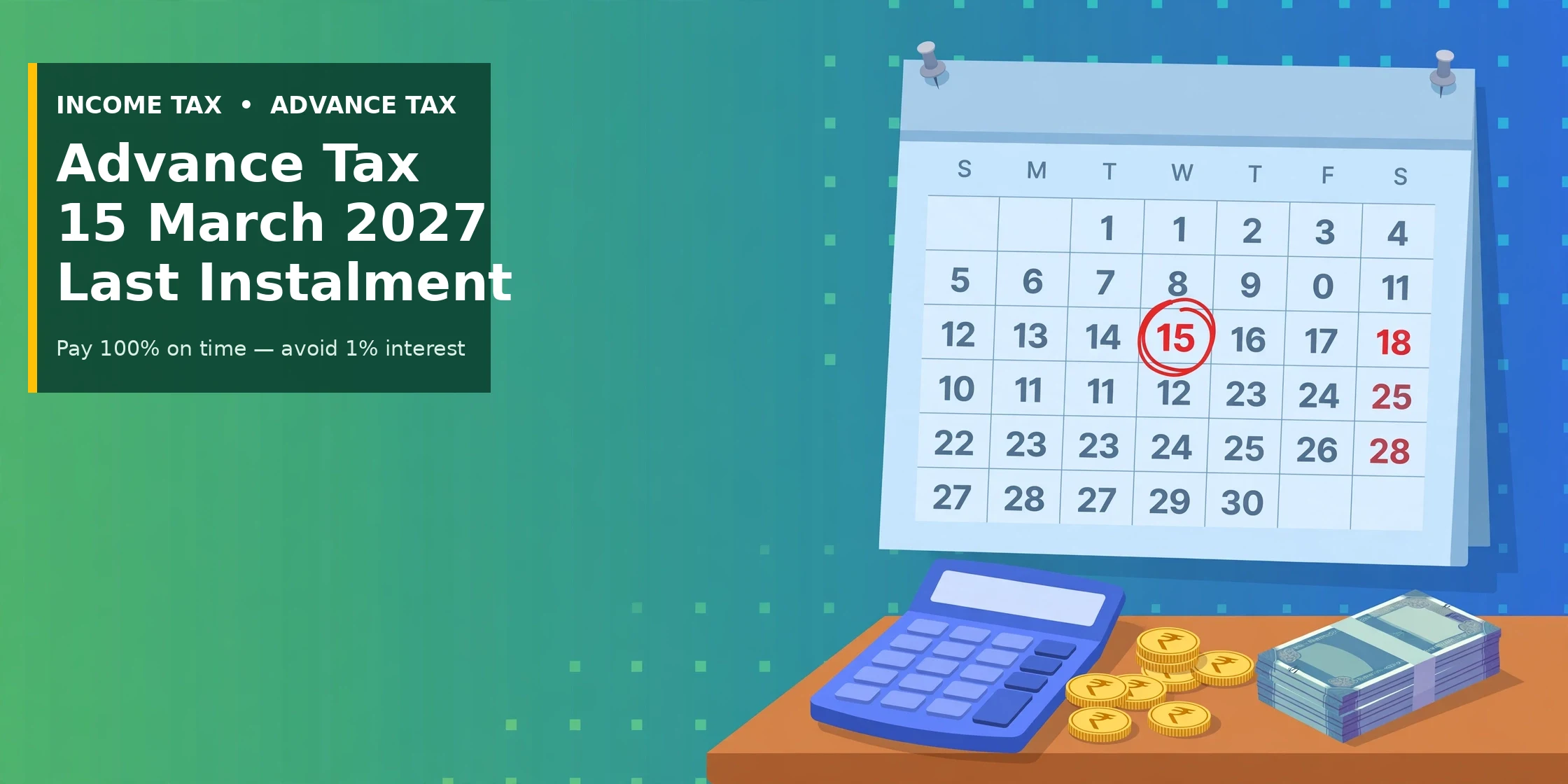
Advance tax is tax you pay during the year, in parts, instead of paying everything at filing time. If you earn income on which no TDS is cut — freelance fees, business profit, rent, interest, capital gains — advance tax is how the tax department collects your share through the year. The last date in the cycle is 15 March 2027, and this guide covers exactly what is due that day, what happens if you miss it, and how to pay.
Advance tax for Tax Year 2026-27 must be fully paid by 15 March 2027, a Monday. By that date you should have paid 100% of your estimated tax for the year, after subtracting TDS and TCS. If you pay less, interest of 1% a month applies under Sections 424 and 425 of the Income-tax Act, 2025.
What is the 15 March 2027 advance tax instalment?
The 15 March 2027 instalment is the fourth and final instalment of advance tax for Tax Year 2026-27 (1 April 2026 to 31 March 2027). By this date, your total advance tax paid for the year must reach 100% of your estimated tax liability.
It is a cumulative target, not a fresh bill. If you have already paid the first three instalments on time, the March payment is only the balance — the last 25% of the year’s tax. If you paid nothing all year, the full 100% is due on this one date.
This instalment matters more than the earlier ones because it is the last chance to finish the year’s tax before the year closes. After 31 March 2027, any unpaid balance stops being advance tax and becomes self-assessment tax, paid when you file your return.
What are the advance tax due dates for Tax Year 2026-27?
Advance tax is paid in four instalments under Section 408 of the Income-tax Act, 2025 (old Section 211 of the 1961 Act). Each date carries a cumulative percentage — the total you should have paid by then, not an extra payment on top of the last one.
| Instalment | Due date | Cumulative tax to be paid | This instalment pays |
|---|---|---|---|
| 1st | 15 June 2026 | 15% | 15% of the year’s tax |
| 2nd | 15 September 2026 | 45% | 30% more, taking the total to 45% |
| 3rd | 15 December 2026 | 75% | 30% more, taking the total to 75% |
| 4th (final) | 15 March 2027 | 100% | 25% more, taking the total to 100% |
To see how this works with round numbers: if your total tax for the year is Rs 1,00,000, you pay Rs 15,000 by 15 June, take the total to Rs 45,000 by 15 September, to Rs 75,000 by 15 December, and pay the last Rs 25,000 by 15 March 2027. All four dates for Tax Year 2026-27 fall on working days, and 15 March 2027 is a Monday, so there is no extension to the next working day.
For the full picture of the earlier instalments, see our guide to the third instalment due 15 December 2026.
How much advance tax do I pay by 15 March 2027?
Work out your total estimated tax for the year first, then subtract the TDS and TCS already credited to you. What is left is your advance tax. By 15 March 2027, 100% of that amount must be paid.
Here is a worked example. A freelancer earns Rs 18,00,000 in Tax Year 2026-27, has no TDS, and uses the new regime:
- Total income: Rs 18,00,000
- Less standard deduction of Rs 75,000: taxable income Rs 17,25,000
- Tax on the new-regime slabs — nil up to Rs 4 lakh, 5% on Rs 4–8 lakh (Rs 20,000), 10% on Rs 8–12 lakh (Rs 40,000), 15% on Rs 12–16 lakh (Rs 60,000), 20% on Rs 16–17.25 lakh (Rs 25,000): Rs 1,45,000
- Add 4% health and education cess (Rs 5,800): total tax Rs 1,50,800
Her instalments for the year:
| Due date | Cumulative target | Amount paid by then | Paid in this instalment |
|---|---|---|---|
| 15 June 2026 | 15% | Rs 22,620 | Rs 22,620 |
| 15 September 2026 | 45% | Rs 67,860 | Rs 45,240 |
| 15 December 2026 | 75% | Rs 1,13,100 | Rs 45,240 |
| 15 March 2027 | 100% | Rs 1,50,800 | Rs 37,700 |
So her March payment is Rs 37,700 — the balance after the December instalment. If her income changes late in the year (a new client in February, a capital gain in March), she should revise the estimate and pay the updated total by 15 March. Paying a little extra is safe: any excess comes back as a refund with interest when the return is processed.
What if I miss the 15 March 2027 deadline?
Missing the date does not end the story, but it starts costing money.
You can still pay by 31 March 2027. Any tax paid on or before 31 March 2027 still counts as advance tax for the year (Section 408(3)). It is not yet self-assessment tax. But interest under Section 425 applies to the March shortfall — 1% for one month on the unpaid amount.
After 31 March 2027, the balance becomes self-assessment tax. You pay it when you file your return for AY 2027-28. The return cannot be filed until the tax, interest and fee are paid, and interest under Section 424 starts running from 1 April 2027 if less than 90% of your total tax was paid by 31 March.
A missed earlier instalment is not fixed by paying in March. Section 425 interest is charged instalment by instalment. Even if you pay 100% by 15 March, a shortfall in June, September or December still carries its own interest for three months each. That is why the March payment is the last chance to stop new interest, not a way to undo the old.
For the return itself, the due dates and the new Act changes are covered in our ITR filing guide for AY 2027-28.
How is the interest on late advance tax calculated?
Two sections charge interest, and they cover different mistakes.
| Section | When it applies | Rate and period |
|---|---|---|
| Section 425 (old 234C) | An instalment was short of its cumulative percentage | 1% per month on the shortfall — 3 months for June, September and December shortfalls; 1 month for the March shortfall |
| Section 424 (old 234B) | Less than 90% of the total assessed tax was paid by 31 March 2027 | 1% per month on the shortfall, from 1 April 2027 until you pay |
The tolerance rule. Section 425 does not apply if you paid at least 12% by 15 June (against the 15% target) or at least 36% by 15 September (against the 45% target). December and March have no tolerance — 75% and 100% must be met in full.
A worked interest example. Suppose your total tax is Rs 1,00,000 and you paid Rs 50,000 by 15 March 2027. The March shortfall is Rs 50,000, so Section 425 interest is 1% for one month: Rs 500. If you still have not paid the balance by 31 March, Section 424 also applies, because only 50% of the tax was paid against the 90% mark.
The capital-gains relief. If a capital gain, lottery winning or similar income arose only after an instalment due date, no Section 425 interest applies to that instalment for that income — as long as you pay the tax on it in the next instalment, or by 31 March if it arose between January and March. A property sold in February, for example, does not make your June and September instalments short.
The full interest rules, with more examples, are in our guide to interest under Sections 423, 424 and 425.
Do presumptive taxpayers pay advance tax in one instalment?
Yes. If you declare income under the presumptive scheme — Section 58 of the Income-tax Act, 2025 (old Sections 44AD for small businesses and 44ADA for professionals) — you do not follow the four-instalment schedule at all. You pay the whole year’s advance tax in a single instalment, on or before 15 March 2027 (Section 408(2)).
Under presumptive taxation, your income is taken as a fixed percentage of your turnover or receipts, instead of being worked out from books of account. That is why the law gives you one date: there is no quarterly profit figure to track. Small businesses with turnover up to Rs 2 crore and professionals with receipts up to Rs 50 lakh can use the scheme.
But the single date is also a single deadline. There is no tolerance and no later instalment to catch up in. A presumptive taxpayer who misses 15 March pays Section 425 interest of 1% for one month on the shortfall, and Section 424 interest from 1 April if the 90% mark is missed. If you use the scheme, mark 15 March 2027 in your calendar now.
Our guide to Section 44ADA presumptive tax for freelancers explains who can opt in and how the income is worked out.
Who does not need to pay advance tax?
Not everyone has to pay in instalments. You do not need to pay advance tax if:
- Your net tax liability is below Rs 10,000. Advance tax applies only when your estimated tax for the year, after TDS and TCS credit, is Rs 10,000 or more (Section 404, old Section 208). Below that, you simply pay the balance when you file.
- You are a resident senior citizen with no business income. If you are 60 or older at any time during the year and have no income from business or profession, you are exempt from advance tax. You pay the full tax as self-assessment tax when you file your return.
- Your TDS already covers the full tax. A salaried person whose employer deducts the full tax each month owes no advance tax. The rule looks at the tax left after TDS — if nothing is left, there is nothing to pay in advance.
Everyone else with income outside TDS — freelancers, landlords, traders, people with capital gains or large interest income — should check the Rs 10,000 test. If your tax after TDS is above it, the four dates apply to you.
How to pay advance tax online in 5 steps
- Log in to the e-filing portal at incometax.gov.in with your PAN and password.
- Open e-Pay Tax from the dashboard and choose Assessment Year 2027-28.
- Under Type of Payment, select Advance Tax (100) — Minor Head 100. Do not select Self-Assessment Tax (300) for a payment made before 31 March.
- Enter the amount, pick your payment mode (net banking, UPI, debit card or credit card), and pay.
- Save the challan with its Challan Reference Number (CRN). The payment shows up in your Form 26AS and AIS within a few days — check it there before you file.
If you pay through your bank’s website instead, choose the same options: Assessment Year 2027-28, advance tax, Minor Head 100. A wrong assessment year or wrong minor head is the most common reason a payment does not match at filing time, so check both before you submit.
What changed under the new Income-tax Act, 2025?
For advance tax, the new Act changed section numbers, not the rules. The dates, percentages, rates and thresholds are the same as before.
| Rule | Old section (1961 Act) | New section (2025 Act) |
|---|---|---|
| Who must pay advance tax | 207 | 403 |
| Rs 10,000 liability trigger | 208 | 404 |
| Instalment dates and percentages | 211 | 408 |
| Interest for paying too little overall | 234B | 424 |
| Interest for late instalments | 234C | 425 |
| Interest for late filing of return | 234A | 423 |
| Presumptive taxation | 44AD / 44ADA | 58 |
Tax Year 2026-27 is the first full year under the new Act, which took effect on 1 April 2026. So the March 2027 instalment is also the first March instalment ever paid under the new section numbers — the old numbers still appear on many websites and calculators, but the law you are paying under is Section 408.
Advance tax by the numbers
- 4 instalments in the year, at 15%, 45%, 75% and 100% — Section 408, Income-tax Act, 2025.
- Rs 10,000 — the tax-liability line above which advance tax becomes compulsory — Section 404.
- 1% per month — the interest rate under both Sections 424 and 425 — Income-tax Act, 2025.
- 90% — the share of total tax that must be paid by 31 March 2027 to avoid Section 424 interest.
- 15 March 2027, a Monday — the final instalment date; the only date for presumptive taxpayers.
Frequently asked questions
What are the advance tax due dates for FY 2026-27?
The four instalments are due on 15 June 2026 (15%), 15 September 2026 (45%), 15 December 2026 (75%) and 15 March 2027 (100%). Each percentage is cumulative, so by 15 March you should have paid the full year’s estimated tax. Presumptive taxpayers pay the whole amount in one instalment by 15 March 2027.
What happens if I miss the 15 March 2027 deadline?
The unpaid balance does not disappear. If you pay by 31 March 2027 it still counts as advance tax, but Section 425 interest of 1% for one month applies to the shortfall. After 31 March the balance becomes self-assessment tax, paid when you file, and Section 424 interest runs from 1 April if less than 90% of your tax was paid.
Can I pay advance tax after 15 March 2027?
Yes, up to 31 March 2027 the payment still counts as advance tax for the year. Interest under Section 425 still applies for the March shortfall, and earlier shortfalls keep their own interest. After 31 March, any payment is self-assessment tax, not advance tax.
Do presumptive taxpayers pay advance tax in one instalment?
Yes. Under Section 58 of the Income-tax Act, 2025 (old Sections 44AD and 44ADA), presumptive taxpayers pay their entire advance tax in a single instalment on or before 15 March 2027. There are no June, September or December instalments for them, and no tolerance if they miss the one date.
What is the interest rate for late advance tax payment?
The rate is 1% per month under both sections. Section 425 charges it on each instalment shortfall — three months for June, September and December, one month for March. Section 424 charges it from 1 April 2027 on the shortfall if less than 90% of the total tax was paid by 31 March.
Who is exempt from paying advance tax?
You are exempt if your tax liability after TDS and TCS is below Rs 10,000, or if you are a resident senior citizen aged 60 or above with no business or profession income. Salaried taxpayers whose employer deducts the full tax also owe no advance tax, since nothing is left to pay.
Official sources
- Income Tax e-filing portal, e-Pay Tax — https://www.incometax.gov.in/iec/foportal/
- Income-tax Act, 2025 — https://www.incometaxindia.gov.in/
- Advance tax instalments and interest — Sections 403, 404, 408, 424 and 425, Income-tax Act, 2025
Reviewed by Asuthod Rathod, CA. Last updated: 13 November 2026.
Disclaimer: This article gives general information about advance tax rules for Tax Year 2026-27. It is not personal tax advice. Tax figures depend on your income, regime and deductions — check the e-filing portal or speak to a qualified CA before you pay.

Editorial byline for eircicai income tax guides — covering the Income Tax Act, 2025, section renumbering, regime comparison, and deductions. Content is reviewed by Asuthod Rathod, CA.