
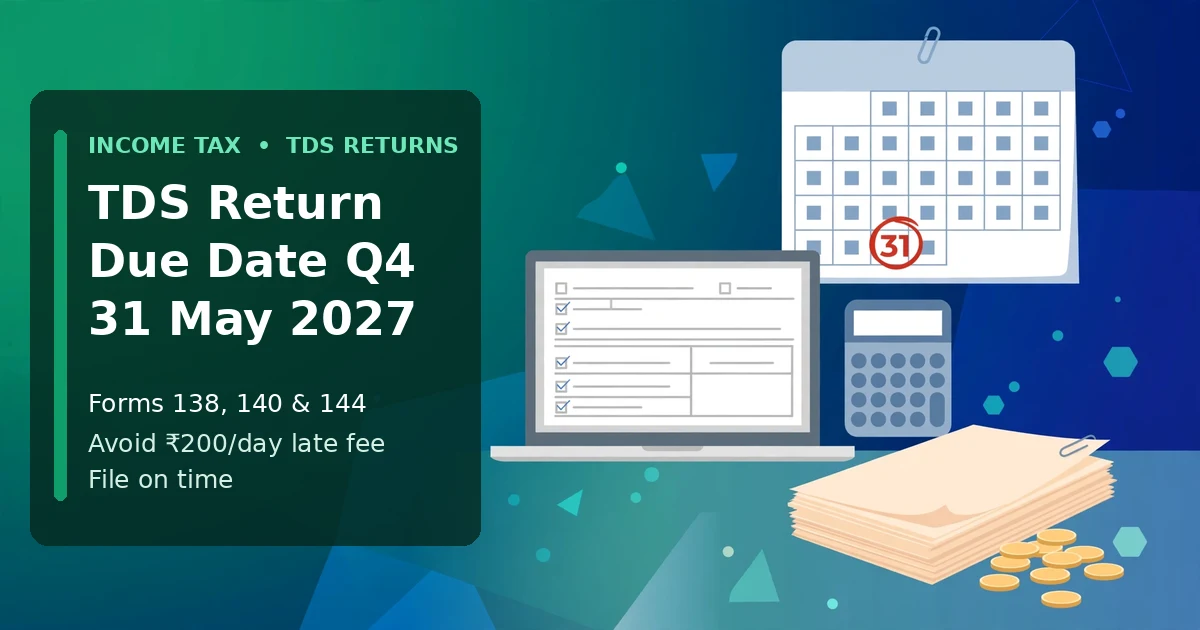
The TDS return due date Q4 for Tax Year 2026-27 is 31 May 2027. That return closes the full financial year, so it needs the most care. Here is what to file, what it costs to be late, and how to file it online.
The Q4 TDS return for Tax Year 2026-27 (1 January to 31 March 2027) is due on 31 May 2027, a Monday. You file it in Form 138 for salary, Form 140 for non-salary payments, or Form 144 for non-residents. File late and a fee of Rs 200 per day applies, capped at your total TDS.
What is the Q4 TDS return due date?
Q4 covers 1 January to 31 March 2027. It belongs to Tax Year 2026-27, which is assessed in Assessment Year 2027-28. The return is due on 31 May 2027, and that day is a Monday.
Every quarter gets a due date after it closes. Q4 gets the longest gap. The other three quarters get about one month. Q4 gets two months, because it closes the entire tax year.
| Quarter | Period covered | Return due date | Gap after quarter ends |
|---|---|---|---|
| Q1 | 1 April – 30 June 2026 | 31 July 2026 | About one month |
| Q2 | 1 July – 30 September 2026 | 31 October 2026 | About one month |
| Q3 | 1 October – 31 December 2026 | 31 January 2027 | About one month |
| Q4 | 1 January – 31 March 2027 | 31 May 2027 | Two months |
Two of these dates need a note. 31 January 2027 falls on a Sunday, so Q3 has a weekend question. 31 May 2027 is a Monday, so Q4 has no weekend-shift issue at all. Your date is 31 May 2027.
As of 14 November 2026, the CBDT has not issued any notification extending the 31 May 2027 date. Notifications can come later. Check incometax.gov.in before you file.
Which form should you file for Q4?
The Income-tax Act, 2025 applies from 1 April 2026. That brought new statement forms for Tax Year 2026-27 onwards. The old form numbers still help, because most software and most accountants still refer to them.
| What you are reporting | New form (TY 2026-27 onwards) | Old form |
|---|---|---|
| Salary TDS | Form 138 | Form 24Q |
| Non-salary domestic payments | Form 140 | Form 26Q |
| Payments to non-residents | Form 144 | Form 27Q |
| TCS collection | Form 143 | Form 27EQ |
Pick your form by the type of payment, not by the size of the payment. If you deduct tax on salaries and also on contractor bills, you file two separate statements: Form 138 for salary and Form 140 for the rest.
Form 143 covers tax collected at source. Its Q4 due date is also 31 May 2027.
One more thing to keep separate. Challan-cum-statements, used for things like property purchase, rent and crypto transactions, follow their own 30-day timelines. They are not part of the quarterly Q4 return. Do not wait for 31 May 2027 to file them.
What changed, what stayed?
Three things changed for Tax Year 2026-27.
- The governing law is the Income-tax Act, 2025, not the 1961 Act.
- The statement forms have new numbers: 138, 140, 144 and 143.
- Section numbers for late fee and penalty changed, as explained below.
What stayed the same matters more for your calendar.
- The quarterly cycle is unchanged. Four returns, four due dates.
- The due-date pattern is unchanged. Q1, Q2 and Q3 get about a month. Q4 gets two.
- The monthly deposit cycle is unchanged. Tax goes in by the 7th of the next month.
- Interest rates on late deposit are unchanged at 1% and 1.5% per month.
- The late filing fee amount is unchanged at Rs 200 per day.
So if you have filed TDS returns before, your working habit still fits. Only the form name and the section number are new.
What are the TDS deposit dates for January, February and March 2027?
Deposit and return are two different jobs. Deposit means paying the deducted tax to the government. Return means reporting it. Missing one does not excuse the other.
| Month tax was deducted | Deposit by | Notes |
|---|---|---|
| January 2027 | 7 February 2027 | Normal deadline |
| February 2027 | 7 March 2027 | Normal deadline |
| March 2027 | 30 April 2027 | Last month of the tax year |
| Any Q4 month (government deductor) | Same day as deduction | Through book entry |
The March date is 30 April 2027, not 7 April 2027. That is the one people mix up most often.
Depositing on time does not excuse a late return. Filing on time does not fix a late deposit. Both duties stand alone.
What happens if you file the Q4 TDS return late?
Two charges can apply. The first is a late filing fee.
Under Section 427 of the Income-tax Act, 2025, the fee is Rs 200 per day. Under the old Act, the same fee came from Section 234E. The amount did not change. Only the section number did.
The clock starts the day after the due date. For Q4, that is 1 June 2027. The fee is capped at the total TDS amount in that return.
Here is a worked example. Suppose your Q4 Form 138 shows total TDS of Rs 50,000. You file on 20 June 2027. That is 20 days late, from 1 June to 20 June.
- Fee = 20 days × Rs 200 = Rs 4,000
- Cap = Rs 50,000
- You pay Rs 4,000, since it is below the cap
You must pay the late fee before the late statement can be filed. The portal will not accept it otherwise.
The second charge is a penalty. Section 461 of the Income-tax Act, 2025 (Section 271H under the old Act) allows a penalty of Rs 10,000 to Rs 1,00,000. This applies if the statement is not filed within one year of the due date, or if it carries wrong details.
There is a safe window. The Rs 10,000 minimum penalty is avoided if you pay the tax, the late fee and the interest, and file the statement within one month of the due date. For Q4, that means on or before 30 June 2027.
So the practical advice is simple. If you miss 31 May 2027, file by 30 June 2027 and clear every dues item. That keeps you away from the Rs 10,000 floor. If you missed an earlier quarter, the same rules applied — see our guide on the missed Q2 TDS return deadline.
How much interest applies on late deposit?
The Income Tax Department TDS rate chart shows two interest rates under Section 201(1A) of the old Act. The same rates continue under the new Act.
- 1% per month if tax was deducted late. That is, you should have deducted earlier but did not.
- 1.5% per month if tax was deducted on time but deposited late.
A month means part of a month. There is no rounding down.
Here is a short example. You should have deducted Rs 10,000 on 10 January 2027. You actually deducted it on 20 January 2027, and deposited it on 15 February 2027 — after the 7 February deposit deadline.
- Late deduction interest: 1% × Rs 10,000 = Rs 100 (one part-month, 10 January to 20 January)
- Late deposit interest: 1.5% × Rs 10,000 = Rs 150 (one part-month, 20 January to 15 February)
- Total interest: Rs 250
Interest is charged on the tax amount, from the date it should have been deducted or deposited, to the date it actually was.
When are Form 16 and Form 16A issued after Q4?
Certificates come after the return. You cannot issue them first.
Form 16 is the annual salary TDS certificate. Under the new Act it becomes Form 130. It is due by 15 June 2027, a Tuesday. It is issued only after your Q4 Form 138 return is filed and processed.
Form 16A covers non-salary TDS. It becomes Form 131. It is due within 15 days of the return due date. For Q4, that also lands on 15 June 2027.
Both dates fall after 31 May 2027, which leaves you about two weeks. That is tight. If your Q4 return is delayed, your certificates are delayed too, and your employees and vendors feel it.
Late issue of a certificate can attract Rs 100 per day per certificate. With 40 employees, that adds up quickly.
How do you file the Q4 TDS return online?
Filing happens on the e-filing portal, and the file is validated against TRACES. Here is the flow.
- Collect your deductee and payment details for January, February and March 2027. Match every entry to a challan.
- Gather challan details: BSR code, challan serial number, tender date, amount and tax deposited.
- Check your PAN verification status for every deductee. Wrong PAN is the most common reason a return gets a default.
- Prepare the statement in the correct form: 138, 140, 144 or 143.
- Validate the statement file against TRACES. Fix every error it flags.
- Log in to incometax.gov.in and upload the validated file.
- Pay any late fee before submitting a late statement.
- Download the acknowledgement and save it. Note the token number.
Keep the acknowledgement, the challans and the validation report together. If a notice arrives later, these three answer most questions.
Can you correct the Q4 return later?
Yes. Corrections are allowed for two years from the end of the tax year. For Tax Year 2026-27, that means you can file a correction statement until 31 March 2029.
That is a long window, and it is useful. Common corrections include a wrong PAN, a missed deductee, a wrong challan link, or a wrong amount.
Two cautions. A correction does not remove the late fee or interest already due. And a correction with wrong details can still attract the Section 461 penalty. File the first return carefully and the correction stays small.
FAQ
What is the last date for TDS return for Q4?
The last date is 31 May 2027. That covers tax deducted from 1 January to 31 March 2027. The date is a Monday. No CBDT notification has extended it as of 14 November 2026.
What is the late fee for filing a TDS return late?
Rs 200 per day, under Section 427 of the Income-tax Act, 2025. It runs from the day after the due date. It is capped at the total TDS in that return. You must pay it before the late statement is accepted.
What happens if I file my TDS return after the due date?
A late fee of Rs 200 per day applies, up to the total TDS amount. Interest may also apply if the tax was deposited late. Your deductees may face defaults, and Form 16 issue gets delayed. File by 30 June 2027 to avoid the Rs 10,000 minimum penalty.
What is the penalty for not filing a TDS return?
Section 461 of the Income-tax Act, 2025 allows Rs 10,000 to Rs 1,00,000. It applies if the statement is more than one year late, or if it has wrong details. The Rs 10,000 minimum is avoided if you pay the tax, late fee and interest and file within one month of the due date.
Which form is used for salary TDS in Q4?
Form 138. It replaces the old Form 24Q from Tax Year 2026-27. If you also deduct tax on non-salary payments, file Form 140 for those. Payments to non-residents go in Form 144.
When is Form 16 issued after Q4?
By 15 June 2027, a Tuesday. It becomes Form 130 under the new Act. It is issued only after the Q4 Form 138 return is filed and processed on TRACES, so a delayed Q4 return delays Form 16 too.
Can I file a TDS return after 31 May 2027?
Yes. The portal accepts late statements. You pay the Rs 200 per day late fee first, plus any interest on late deposit, and then file. File by 30 June 2027 to stay clear of the Rs 10,000 minimum penalty under Section 461. After that, the fee keeps running until you file, capped at the total TDS in the return.
Official Sources
- Income Tax Department, e-Filing portal — incometax.gov.in
- TRACES (TDS Centralized Processing Cell) — tdscpc.gov.in
- Income Tax Department, TDS compliance — incometaxindia.gov.in
Reviewed by Asuthod Rathod, CA. Last updated: 14 November 2026.
Disclaimer: This article is general information for Tax Year 2026-27 and is not professional tax advice. Due dates and forms can change through CBDT notifications. Check the official Income Tax Department portal before filing, and speak to a chartered accountant for your own case.

Editorial byline for eircicai income tax guides — covering the Income Tax Act, 2025, section renumbering, regime comparison, and deductions. Content is reviewed by Asuthod Rathod, CA.