
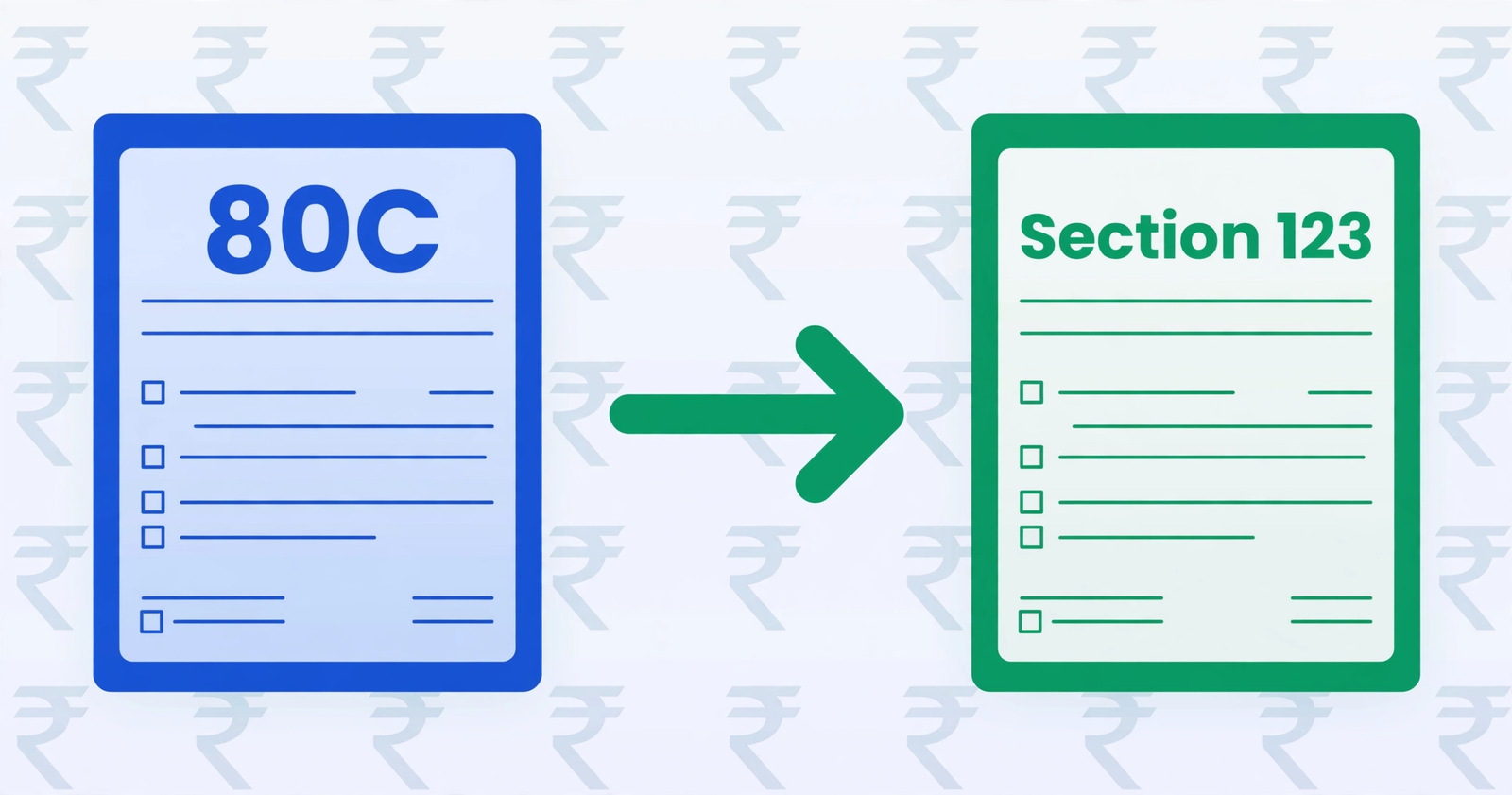
Quick answer: the 80C new section number is Section 123. Section 80C of the old Income Tax Act, 1961 is now Section 123 of the new Income Tax Act, 2025. Nothing about the deduction itself has changed — the ₹1.5 lakh limit is the same, the eligible investments are the same, the rules are the same. Only the section number is different. If you file under the old tax regime, you will now write “Section 123” instead of “Section 80C” on your return.
If you have been filing income tax returns for a few years, “80C” is probably the first section number you ever learned. PPF, ELSS, EPF, life insurance — all of it went under 80C. It was simple and everyone knew it.
Now the government has replaced the entire Income Tax Act, 1961 with the Income Tax Act, 2025. The new Act applies to income earned from 1 April 2026 onwards. And with a new Act come new section numbers.
This article tells you exactly what happened to 80C (the 80C new section number is 123), what changed, and — more importantly — what did not change. By the end, you will know whether you need to do anything differently. (Short version: you don’t.)
Old vs New Section Numbers
Here is the mapping for 80C and the deductions around it — including the 80C new section number. These numbers are confirmed and agreed across official sources:
| Old section (1961 Act) | New section (2025 Act) | What it covers |
|---|---|---|
| 80C | 123 | PPF, EPF, ELSS, NSC, life insurance, etc. |
| 80CCC | 123 | Pension fund contributions (merged with 80C) |
| 80CCD(1) | 124 | NPS employee contribution |
| 80CCD(1B) | 124 | NPS additional ₹50,000 deduction |
| 80D | 126 | Health insurance premium |
| 80E | 129 | Education loan interest |
| 80G | 133 | Donations |
| 80TTA | 153 | Savings account interest (₹10,000) |
| 87A | 156 | Tax rebate |
A few things to notice in this table:
- 80C and 80CCC both became Section 123. They were always clubbed under the same ₹1.5 lakh limit, so the new Act just merged them properly.
- 80CCD(1) and 80CCD(1B) both became Section 124. Same treatment — they were always one deduction with two parts.
- 80TTA became Section 153 and now covers what 80TTB used to cover separately. One less section to remember.
The rest of this article focuses on Section 123 (the old 80C, now the 80C new section number), since that is the one most people actually use.
What Stayed the Same
This is the good news: apart from the 80C new section number itself, almost everything stayed the same.
The ₹1.5 lakh limit is unchanged
You can still claim up to ₹1,50,000 per year under Section 123. This limit is shared across all the investments listed under it — PPF, EPF, ELSS, NSC, life insurance premium, and the rest. Put ₹1.5 lakh in PPF and ₹50,000 in ELSS? You still only get ₹1.5 lakh of deduction, not ₹2 lakh. That rule has not changed.
The eligible investments are unchanged
Every investment that qualified under 80C still qualifies under Section 123:
- PPF (Public Provident Fund)
- EPF (your employee provident fund contribution)
- ELSS (tax-saving mutual funds, 3-year lock-in)
- NSC (National Savings Certificate)
- Life insurance premiums (LIC and private insurers)
- Sukanya Samriddhi Yojana (for a girl child)
- Senior Citizens Savings Scheme (SCSS)
- Tax-saving FDs (5-year lock-in)
- Children’s tuition fees (school/college fees, up to 2 children)
- Home loan principal repayment
- ULIPs (within the usual conditions)
- NPS — note this has its own section now (124), but the combined-limit logic with 123 works the same as before
If it gave you a deduction under 80C last year, it gives you a deduction under Section 123 this year.
The old regime vs new regime rule is unchanged
This is important and many people get confused here. The new Act did not change which regime allows the deduction:
- Old tax regime: Section 123 deduction is available (just like 80C was).
- New tax regime (now Section 202): Section 123 deduction is not available (just like 80C was not).
So the regime choice works exactly the way it did before. If you picked the old regime to claim 80C, you now pick the old regime to claim Section 123. Same logic, new number.
Lock-in periods are unchanged
ELSS still has a 3-year lock-in. PPF still runs 15 years. Tax-saving FDs still need 5 years. NSC still matures in 5 years. None of this moved.
What Actually Changed
Honestly? Very little. Apart from the 80C new section number, here is the complete list:
1. The 80C new section number: 80C → 123
That is the main change. Wherever you used to write or say “80C,” you now write or say “Section 123” — the 80C new section number. Tax forms, ITR utilities, and Form 16 will show the new number.
2. “Previous year” is now “tax year”
The old Act talked about the “previous year” (the year you earned income) and the “assessment year” (the year you file). The new Act uses a single term: “tax year.” The assessment year concept is gone.
What does this mean for Section 123? When you see “tax year 2026-27” on a form, it means the same thing “previous year 2026-27” used to mean — the year from 1 April 2026 to 31 March 2027.
3. 80CCC is merged into the same section
Under the old Act, pension fund contributions had their own section (80CCC) but shared the ₹1.5 lakh limit with 80C. Under the new Act, both sit inside Section 123 directly. Cleaner, but the money math is identical.
4. The Act itself is shorter and simpler
The 2025 Act has 536 sections, 23 chapters and 16 schedules. The language is meant to be plainer and easier to follow. The language is meant to be plainer. For a normal taxpayer claiming the standard deductions, you will not feel this difference. It matters more to CAs and tax lawyers.
That is it. That is the full list of changes for a Section 123 claimant — and for everyone searching for the 80C new section number.
Practical Impact: Do You Need to Do Anything Differently?
No. Here is your checklist for tax year 2026-27:
-
Invest the same way. Keep your PPF, ELSS, EPF, insurance exactly as before. Nothing about your investment plan needs to change because of the new section number.
-
Claim under the old regime. If the old regime saves you more tax (it usually does when your deductions cross roughly ₹3.75 lakh at ₹15 lakh income), opt for it and claim Section 123.
-
Write “Section 123” on forms. When the ITR utility or your CA asks for the section, use 123 instead of 80C — that is the 80C new section number. The updated ITR forms for tax year 2026-27 will show the new numbers.
-
Do not panic about old documents. Your PPF passbook, ELSS statements, and insurance receipts do not mention section numbers. They are still valid proof.
-
Form 16 will update automatically. Your employer’s payroll and Form 16 (itself renumbered — Form 16 is now a different form number under the new rules) will reflect Section 123. You do not need to tell your employer anything.
The one thing to watch: in the first year of transition, some tax portals and utilities may show both numbers (“Section 123 (earlier 80C)”) to help people adjust — the 80C new section number is still sinking in. That is normal.
Frequently Asked Questions
Is 80C gone?
No. The deduction is fully alive. It just has a new address: Section 123 of the Income Tax Act, 2025 — the 80C new section number. Same limit, same investments, same rules.
Do I need to change my investments because of the new Act?
No. Your PPF, ELSS, EPF, NSC, and insurance all qualify exactly as before. The new Act changed section numbers, not investment rules.
Which ITR form do I use for Section 123?
The same ITR form you used before, based on your income type — ITR-1 for salary, ITR-2 for capital gains, ITR-3/4 for business. The forms for tax year 2026-27 will show “Section 123” (the 80C new section number) where they used to show “80C.” Pick the form the same way you always did.
What about NPS (80CCD)?
NPS moved to Section 124. The ₹50,000 extra deduction under 80CCD(1B) is still there under Section 124. Employer NPS contributions have their own treatment as before. Nothing changed except the number.
Does the new tax regime allow Section 123?
No — same as before. The new regime (now Section 202, earlier 115BAC) does not allow the Section 123 deduction. If this deduction matters to you, compare both regimes before choosing. The new regime is the default, so you have to actively opt for the old regime.
When does Section 123 apply from?
Income earned from 1 April 2026 (tax year 2026-27). Income earned in FY 2025-26, which you file in July 2026, still goes under the old Act with the old “80C” number. The switch happens for the following year, when the 80C new section number (123) takes effect.
Disclaimer: This article is for general information only and is not professional tax advice. Tax laws change frequently. The section mappings here are based on the Income Tax Act, 2025 as published; always verify against the official Act or consult a qualified Chartered Accountant for advice specific to your situation.
Reviewed by Asuthod Rathod, CA
Last updated: 10 October 2026
This article is for general information only and is not professional tax advice. Tax laws change frequently — verify with official sources or consult a qualified CA for your specific situation.
Official Sources
- Income Tax Department — the official portal for e-filing and ITR utilities.
- India Code — read the full text of the Income Tax Act, 2025 as published.

Rohan has been writing about Indian income tax for over 5 years. He breaks down complex tax rules into simple language that anyone can understand. His guides focus on practical filing tips, deduction strategies, and keeping up with the new Income Tax Act 2025.