
Quick answer
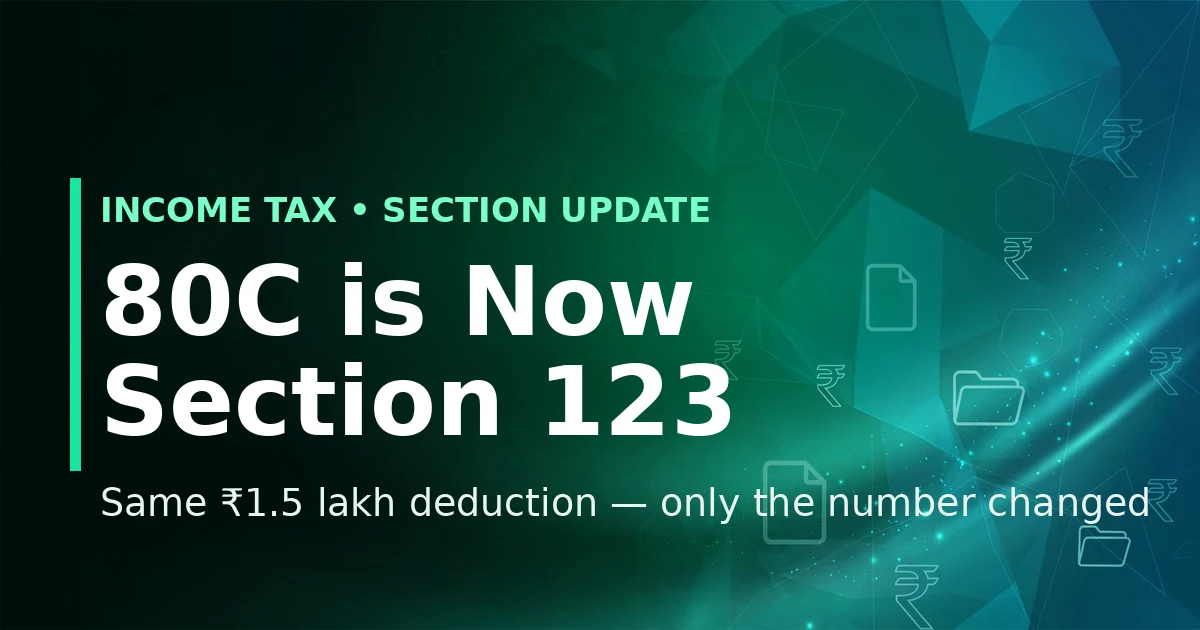
- Old Section 80C of the Income-tax Act, 1961 is now Section 123 of the Income-tax Act, 2025.
- The deduction limit is unchanged: ₹1.5 lakh per year.
- All eligible investments (PPF, EPF, ELSS, LIC, NSC, home loan principal, tuition fees) are the same.
- It is still available only under the old tax regime.
- For income earned up to 31 March 2026, keep quoting “80C”. Section 123 applies from tax year 2026-27 (1 April 2026 onward).
What actually changed
The Income-tax Act, 2025 replaced the 1961 Act from 1 April 2026. It is mainly a clean-up job: 819 sections became 536, the language is simpler, and the old pair of “financial year” and “assessment year” is now just one tax year (1 April to 31 March).
In this renumbering, the deduction you knew as Section 80C became Section 123. The full list of eligible investments and expenses now sits in Schedule XV of the new Act instead of being scattered across the old chapter.
One practical point: from tax year 2026-27 onward, your investment declaration to your employer should say “Section 123” where it used to say “80C”. Payroll systems are being updated for this. But your Form 16 for salary earned in FY 2025-26 (up to March 2026) still says 80C — and that is correct. Use the old number for old-year income, the new number for the new tax year.
What stayed exactly the same
The ₹1.5 lakh limit
The ceiling is still ₹1.5 lakh per year, combined across every eligible item. It is not ₹1.5 lakh per instrument. If you put ₹1 lakh in PPF and ₹1 lakh in ELSS, your deduction is ₹1.5 lakh, not ₹2 lakh. This combined ceiling also covers Sections 80CCC and 80CCD(1) — all three share the one ₹1.5 lakh cap. It has not moved since FY 2014-15.
The extra ₹50,000 for NPS
The additional NPS Tier-1 deduction under Section 80CCD(1B) continues — old regime only. With it, your combined deduction can reach ₹2 lakh (₹1.5 lakh under Section 123 + ₹50,000 under 80CCD(1B)).
The eligible investments
Everything you could claim before, you can still claim. The table below covers the main ones.
| Investment / expense | Lock-in | Rough return profile |
|---|---|---|
| ELSS mutual funds | 3 years | Market-linked equity |
| PPF | 15 years (partial withdrawal from year 7) | ~7.1%, set by government |
| EPF — employee share | Until retirement / exit | ~8.25%, set by government |
| NSC | 5 years | ~7.7%, fixed |
| 5-year tax-saving FD | 5 years | ~6–7.5%, interest fully taxable |
| Sukanya Samriddhi Yojana | Until the daughter turns 21 | ~8.2%, girl child only |
| Senior Citizens Savings Scheme | 5 years | ~8.2%, age 60+ |
| ULIPs | 5 years | Market-linked, but high charges |
| Life insurance premium (self, spouse, children) | Policy term | Protection + savings |
| Home loan principal repayment | — | Saves interest indirectly |
| Children’s tuition fees (up to 2 children) | — | Full-time education at Indian institutions |
| Stamp duty + registration on house purchase | — | In the year of purchase only |
Three fine-print rules people trip on:
- Life insurance premium counts only if the sum assured is at least 10 times the annual premium, for policies issued on or after 1 April 2012. If it fails this test, only a proportionate amount is allowed.
- Tuition fees mean fees paid to a school, college, or university in India for full-time education of up to two children. Coaching fees, donations, hostel charges, and private tuition do not count.
- Home loan principal: if you sell the property within 5 years of taking possession, all the 80C deductions you claimed on its principal get reversed — added back to your income in the year of sale.
Is Section 80C available in the new tax regime?
No. This is the single most important fact in this article, so here it is plainly: Section 123 (old 80C) works only under the old tax regime. If you file under the new regime — now Section 202 of the 2025 Act, earlier Section 115BAC — your PPF, ELSS, LIC premium, EPF, and home loan principal give you zero deduction.
The only investment-linked deduction that survives in the new regime is the employer’s NPS contribution under Section 80CCD(2). Everything else needs the old regime.
This creates a simple yearly decision. Rough rule of thumb: if your total deductions (80C/123 plus 80D medical insurance, HRA, home loan interest) cross about ₹4–4.5 lakh, the old regime usually wins. Below that, the new regime’s lower slabs usually win. Run your own numbers both ways before you file — the answer changes as your salary and loans change.
What this saves you in real money
At the 30% slab, a full ₹1.5 lakh claim saves ₹46,800 including the 4% health and education cess. At 20%, it saves ₹31,200. At 5%, ₹7,800. These numbers are identical to last year — only the section number changed.
Practical impact for tax year 2026-27
- Investment declarations: when your employer asks for your tax-saving declaration for the new tax year, write “Section 123” where you used to write “80C”. The deduction logic is the same; only the reference changed.
- Form 16 timing: the Form 16 you receive in mid-2026 for FY 2025-26 salary still shows 80C. That is correct, not an error. The first Form 130 (the renamed Form 16) will relate to tax year 2026-27.
- ITR forms: they are being updated to the new numbering. If a form still says 80C for an old-year filing, use it as-is.
- Missed the employer deadline? You can still claim eligible 80C/123 investments while filing your ITR, even if you never submitted proof to your employer — as long as the investment was made during the tax year. Keep the documents.
Common mistakes to avoid
- Assuming 80C works in the new regime. It does not. The new regime gives you nothing for PPF, ELSS, or LIC.
- Counting the employer’s EPF share. Only your (employee’s) contribution counts toward the ₹1.5 lakh limit. The employer’s matching share is exempt under a separate provision and does not sit in 80C.
- Adding up to more than ₹1.5 lakh. The ceiling is combined. Five investments of ₹50,000 each still give you ₹1.5 lakh of deduction.
- Claiming coaching or hostel fees as tuition. Only tuition fees to recognised Indian institutions for full-time education qualify.
- Selling the house early. Selling within 5 years of possession reverses your home-loan-principal deductions.
FAQ
Do I quote Section 123 or Section 80C for my FY 2025-26 investments?
Quote Section 80C. The 1961 Act governs income earned up to 31 March 2026, so the old number is correct for that year’s filing — it is not outdated. Section 123 applies to tax year 2026-27 onward.
Is Section 80C available in the new tax regime?
No. Section 80C (now Section 123) is available only under the old tax regime. In the new regime, none of these investments create a deduction. The only related deduction in the new regime is the employer’s NPS contribution under Section 80CCD(2).
What is the maximum deduction limit under Section 80C?
₹1.5 lakh per year. It is a single combined ceiling across all eligible investments and expenses, and it also covers Sections 80CCC and 80CCD(1). Investing more is allowed, but it does not increase the deduction. With the extra NPS deduction under 80CCD(1B), the combined figure can reach ₹2 lakh.
Which is better under 80C: PPF or ELSS?
They do different jobs. ELSS is market-linked equity with the shortest 80C lock-in (3 years) — good for growth if you can handle ups and downs. PPF is government-backed with a 15-year horizon — good for the safe part of long-term goals. Many salaried taxpayers use both: ELSS for growth, PPF for stability, layered around EPF and home loan principal that are already filling part of the ₹1.5 lakh.
Does my EPF contribution count toward the 80C limit?
Yes — your employee share of EPF counts toward the ₹1.5 lakh ceiling. Check Form 16 Part B for the exact figure before planning extra investments. The employer’s matching contribution does not count in 80C.
Can I claim 80C in my ITR if I didn’t submit proof to my employer?
Yes. If the investment or payment was made during the tax year, you can claim the deduction while filing your return even without an employer declaration. Keep the receipts and policy documents in case of scrutiny.
Can NRIs claim the 80C deduction?
Yes. NRIs can claim 80C (Section 123) deductions, but only against income earned in India and only under the old tax regime.
Official sources
- Income-tax e-filing portal: https://www.incometax.gov.in
- CBDT / Income Tax Department: https://incometaxindia.gov.in
Reviewed by Asuthod Rathod, CA.
Last updated: 11 October 2026
Disclaimer: Tax rules change often. Check incometax.gov.in or ask a qualified professional before you decide.

Editorial byline for eircicai income tax guides — covering the Income Tax Act, 2025, section renumbering, regime comparison, and deductions. Content is reviewed by Asuthod Rathod, CA.